

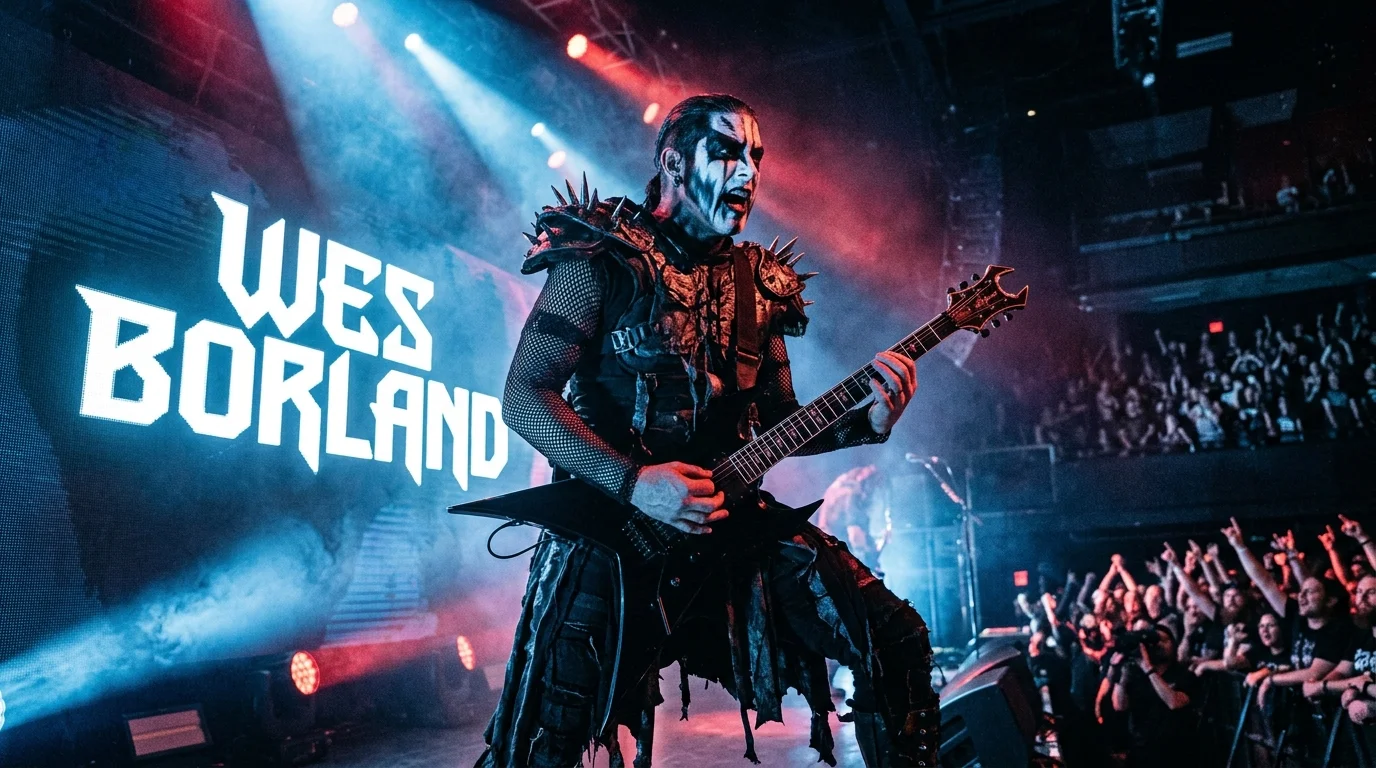
Wes Borland is an American guitarist, songwriter and visual artist best known as the guitarist of Limp Bizkit, with an estimated net worth of $10 million in 2026, according to Celebrity Net Worth. He is 51 (born February 7, 1975), and his experimental guitar style, elaborate costumes and face paint have made him one of the most recognizable musicians in nu metal.
His career extends far beyond one band. He has recorded solo music, led Black Light Burns, formed Big Dumb Face with his brother, created visual art, and continued touring while exploring new sounds. He remains a member of Limp Bizkit, which released its first new song in four years in September 2025.
| Quick Fact | Details |
|---|---|
| Full name | Wesley Louden Borland |
| Date of birth | February 7, 1975 |
| Age | 51 (born February 7, 1975) |
| Birthplace | Richmond, Virginia, United States |
| Profession | Guitarist, songwriter, vocalist, visual artist |
| Best known for | Limp Bizkit |
| Major side projects | Big Dumb Face, Black Light Burns |
| Solo albums | Crystal Machete (2016), The Astral Hand (2020), Mutiny on the Starbarge (2023) |
| Reported height | 6 ft 1 in (1.85 m) |
| Net worth | $10 million (Celebrity Net Worth) |
His Wikipedia biography gives his full name as Wesley Louden Borland and his birth as February 7, 1975, in Richmond, Virginia; he later grew up musically in Jacksonville, Florida. IMDb lists his height as 6 feet 1 inch.
Who Is Wes Borland?
Borland became internationally known as the guitarist and backing vocalist of Limp Bizkit, the Jacksonville band whose mix of rap, metal, rock, and hip-hop became commercially successful around the turn of the millennium.
Limp Bizkit released its debut album, Three Dollar Bill, Y’all, in 1997. The group’s breakthrough accelerated with Significant Other (1999) and Chocolate Starfish and the Hot Dog Flavored Water (2000), both of which became major commercial hits.
While Fred Durst became the band’s outspoken frontman, the guitarist developed a contrasting stage identity. His painted face, masks, unusual clothing, black contact lenses, and handmade visual concepts became a major part of the group’s image.
That contrast was intentional. In an interview with The Believer, he explained that the other members did not want to dress up, leaving him as the visually unconventional figure alongside four comparatively conventional-looking bandmates.
How His Guitar Style Became So Distinctive

His playing often centers on rhythm, texture, effects, unusual tunings, and abrupt changes rather than traditional lead-guitar showmanship.
In a Guitar World interview about Black Light Burns, he described himself as someone more interested in songwriting and conveying emotion than in becoming a virtuoso or shred-focused player. That approach helps explain why his riffs often serve the song’s atmosphere rather than stand as isolated technical showcases.
He has also cited players from bands such as Helmet, Prong, Metallica, Primus, and The Jesus Lizard as influences. His musical tastes extend well beyond the genre most commonly associated with Limp Bizkit.
His gear choices reflect the same practical approach. He began endorsing Jackson Guitars around the time of Gold Cobra and has played several Jackson models.
Leaving and Returning to Limp Bizkit
His relationship with Limp Bizkit has never been straightforward.
He left the band in fall 2001, citing creative differences. He rejoined in August 2004 for The Unquestionable Truth (Part 1) (2005), stepped away again, and then reunited with the original lineup in 2009. He later appeared on Gold Cobra in 2011 and Still Sucks in 2021.
Those departures gave him room to explore ideas that did not fit within Limp Bizkit.
Black Light Burns became one of his most substantial outside projects. The group’s 2007 debut, Cruel Melody, grew out of material he developed after leaving Limp Bizkit. He formed the band in 2005, sang and played guitar on the album, and the project ran until 2016.
Big Dumb Face took a more eccentric direction. The project, formed with his brother Scott in 1998, mixed metal with comedy and abrupt stylistic shifts. Its releases include Duke Lion Fights the Terror!! (2001), Where Is Duke Lion? He’s Dead… (2017) and Christmas in the Cave of Dagoth (2021).
His solo catalog reveals another side of his creativity. It includes the albums Crystal Machete (2016), The Astral Hand (2020) and Mutiny on the Starbarge (2023), plus the 2018 EP Matadors and Daughters.
The Visual Artist Behind the Stage Costumes
Music is only one part of his creative work.
He has long been interested in painting, sculpture, costume design, and visual storytelling. His stage outfits are not simply promotional styling arranged by a band wardrobe department. His artistic background has helped shape the characters audiences see on stage.
That connection between sound and image is one reason his appearance changes so often. One show may feature skeletal makeup, while another may involve formal clothing, masks, body paint, or a character that looks completely different from the one used on a previous tour.
The consistency lies in the concept, not the costume itself. His visual choices make each performance feel carefully constructed rather than routine.
Personal Life
Borland has been married three times, most recently, in 2016, to Carré Callaway, singer of the band Queen Kwong. His first two marriages ended in divorce, and his Wikipedia biography records that Callaway filed for divorce in 2019.
After moving to Detroit, he and Callaway renovated a large house in the Arden Park district on the DIY Network series Sight Unseen (2016).
Wes Borland Net Worth
Celebrity Net Worth estimates Wes Borland’s net worth at $10 million. Like all celebrity net worth figures, it is an outside estimate rather than audited or confirmed wealth.
His income comes from Limp Bizkit’s multi-platinum records and decades of touring, songwriting, side projects and solo releases. Real estate has added to it: Celebrity Net Worth reports that he bought a Los Angeles home for $600,000 in 2002 and sold it for $1.23 million in 2015, and that he bought his Detroit house for $500,000 in 2015 and sold it for $760,000 in 2021. In October 2024, Limp Bizkit, including Borland, sued Universal Music Group, alleging more than $200 million in unpaid royalties; a federal judge dismissed 14 of the claims in March 2025 while allowing the copyright claim to proceed.
What Is He Doing in 2026?
The guitarist remains professionally active.
Limp Bizkit has continued touring. In September 2025, the band released “Making Love to Morgan Wallen,” its first new song in four years, on the Battlefield 6 soundtrack, and Fred Durst had confirmed in 2024 that work on a seventh album had begun.
The group is also moving forward after the death of founding bassist Sam Rivers on October 18, 2025, at age 48. Richie Buxton of Ecca Vandal has since handled bass duties on the road.
That makes 2026 a significant period in his career, marked by continued touring, new music and a band adjusting to a major personal loss.
Frequently Asked Questions
What is Wes Borland known for?
He is best known as Limp Bizkit’s guitarist and backing vocalist. He is also recognized for his experimental guitar work, elaborate stage makeup, costumes, visual art, Black Light Burns, Big Dumb Face, and solo recordings.
How old is Wes Borland?
He is 51 years old. He was born on February 7, 1975, in Richmond, Virginia.
How tall is he?
IMDb reports his height as 6 feet 1 inch, or approximately 1.85 meters.
Is he still in Limp Bizkit?
Yes. He remains the band’s guitarist and has continued touring with Limp Bizkit after the death of bassist Sam Rivers in 2025.
What is his net worth?
Celebrity Net Worth estimates his net worth at $10 million, earned through Limp Bizkit, side projects, solo work and real estate.
Why is his stage appearance so unusual?
Visual art and costume design have been part of his creative identity for decades. His makeup, masks, clothing, and characters allow him to treat live performance as both a musical and visual experience.